Did you know that a dot, when placed vertically in the middle, is called an interpunct?
As usual, there are several Unicode code points for interpunct (or interpunct-like characters), including:
- U+00B7 · MIDDLE DOT
- U+22C5 ⋅ DOT OPERATOR
- U+1427 ᐧ CANADIAN SYLLABICS FINAL MIDDLE DOT (used in some Indigenous languages in Canada)
- U+A78F ꞏ LATIN LETTER SINOLOGICAL DOT (what on earth does that mean?)
But anyway, going back to what prompted my query: if I should use a cross ($\times$) or a dot ($\cdot$) for multiplication in a equation written over multiple lines (and a line break occurs in the middle of a multiplication). The two signs are obviously not interchangeable in many contexts (e.g., vector multiplication), but in my case it did not matter.
During my search, I learnt that (apparently) some British conventions avoid using the · for multiplication (thanks, Reddit).1 The reason—again, apparently—is that the interpunct was used as the decimal sign in the UK well into the 20th century (and even today!), that is, people write 167·12 instead of 167.12 to mean one hundred sixty-seven and twelve hundredths.

Indeed, while Nature has changed its practice in/around 1971,2 The Lancet still continues the interpunct tradition to this day. Comments on Reddit and Academia Stack Exchange3 also suggest that many British pupils were (are?) taught to always place the decimal point vertically in the middle.
I also came across two articles4 in Nature about the choice of decimal separators in the UK (in the context of currency decimalization). The interpunct had been a traditional British practice, but the British Standards Institution (BSI) advocated for using commas (as in much of continental Europe). The Decimal Currency Board (DCB) favoured the traditional system. One reason was that the BSI also favoured using spaces as thousands separators, which banks thought would be vulnerable to fraud attempts. BSI gave up in 1968, even though some industries had started to use the space/comma system.
The government seemed to have intended to preserve the raised dot/interpunct as the decimal separator, but recognized the usage of full stop/dot on the baseline as a valid alternative in typed documents.5
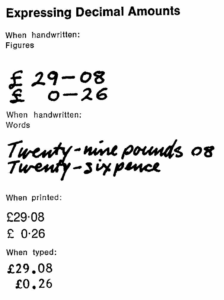
The point on the line gradually became universally adopted in the UK, apart from a few holdouts (e.g., the aforementioned The Lancet), probably due to the lack of interpunct on typewriters and computer keyboards.
As for myself, I prefer the Swiss banking convention: 1’234’567.89.
- https://www.reddit.com/r/math/comments/od0i6w/british_maths_doesnt_use_the_multiplication_sign/ (archived) ↩︎
- Compare the decimal numbers in the tables in Nature 228, 1269 (1970) and Nature 229, 17 (1971) ↩︎
- https://academia.stackexchange.com/questions/117982/central-dot-as-decimal-point-in-top-journal
↩︎ - Victory on Points. Nature 218, 111 (1968). DOI: 10.1038/218111c0;
Full Stop on Decimals. Nature 217, 995 (1968). DOI: 10.1038/217995b0 ↩︎ - Decimal Currency: Booklet on Written and Printed Forms. Building: Metrication News 121 (March 22, 1968). ↩︎
Leave a Reply